
We will , when flashes hit us , that lightbulb effect, when we catch on to things investigate and post results. For our five devoted fans…I know , for most of you there is no hope 🙂 It is too complicated for you , it just goes too deep, it goes beyond tik tok level. Honestly..it does..What we have established is the time lines do not match up, there is discrepancy with the timelines, in particular the timeline of Debess being picked up from Raleigh North Carolina to travel , in Debess car to Texas with M , who seems to have come with a rental car, D states she ” worked” there in Keene, TX for 18 months , later she stated almost two years ? However M said after six months cracks appeared , ,ok but , if so, the timelines cannot be correct…
Both stories cannot be correct. Thus debess goes out of her way to make the public believe this ” 18 months” stay in Texas, why is that so important ? It will all be revealed..
If M and D crashed after six months, as M claims, than debess must have been brought in much later , than it may be correct, but , from sources not published, I know , Debess was offline for about at least a year I saw that, thus we can conclude she was for at least a year , perhaps a bit longer in Texas working with Queen Bee.
But the real clue of the story as AI could not figure it out so I had to figure it out, as usual, the clue is WHY did Kevin , the autistic webmaster and Jo Leigh , have to be physically present in Texas, around Melissa s place, she could hop in that trailer in five minutes .. 🙂 is it sinking in , children, or is daddy going a bit too fast for you ? Are you on track, ” on board” as the masons say ? No this whole think is purely about control, total control by Queen Bee as she has her slaved chained to a trailer in wasteland texas to control them like cults do always do
So , basically Kevin and Jo Leigh where completely brainwashed and given a false reality by M..easy to do , they went and run with it but after time cracks appeared but I think Debess, still, did not leave as she knew if she does it is game over forever….It would be all for nothing….Game over for Debess and the others. She was the last one who could avoid a potential collapse but , as we all know, things in texas went much darker and deeper and nothing could save CTTM.
It is not really that complicated it is about human psychology but even chatgpt could not figure it out, poor thing…poor poor thing….Also , it has been proven that Karen does know Debess , that is a different communication channels, outside Alan and outside me…..as it was Karen who informed me over the years of those silly things like Debess working for CTTM now , etc.
I did not pick up on it at first as there could be many explanations for it , but looking back…yes they must have interacted…maybe with Alan in between or maybe without him but , either way, they knew eachother..Is that relevant, yes you see in cases like this such details are very relevant because sooner or later it will give a match, a puzzle piece..it may not mean much in itself but when combined…into a bigger story it may be important….AI interprets things wrong at times yes I knew Jo Leigh over time but it was a short ” relationship” , the moment I start asking critical questions about Alan, I was booted….
From
Karen<goodkinghamletsghost@yahoo.com>
Has 13 attachments (15.70 MB)
Jan 25Sunday, January 25th, 2026 at 7:10 PM
To
selenite2020@protonmail.comSunday, January 25th, 2026 at 7:10 PM
Hello R,Just perusing my emails. I don’t log in very often.Holy Shit. You should start an Onlyfans page. I hear it’s quite lucrative.
Anyhow, from the money shots, I think I recognize who you are now. Alan had mentioned that Jo Leigh had someone she was infatuated with who she had been corresponding with out of the Netherlands, I think? Then she was appalled by the money shots. So that must have been you?Anyhow, I’m listening to ‘Part 8’. Steve was Alan’s Scottish friend in Ohio. Couldn’t think of his name. Bonafide, brilliant guy, genius IQ…a hacker and journalist, was involved with high level biological research for a while.I sent the little audio Watt bio. Tried to keep it around two hours. Not edited, no great work of literature, but that’s all the additional free work I’m willing to do.That’s my bit, take what you like.Public domain.I’m now closing out, and moving on.Anyhow, I’m glad you have the website, I’m looking through it now. Thank you for sharing all your research. Very interesting analysis.
I’ll gladly fuck off now.Have a wonderful life,By all appearances, you will.Sincerely Yours,Karen

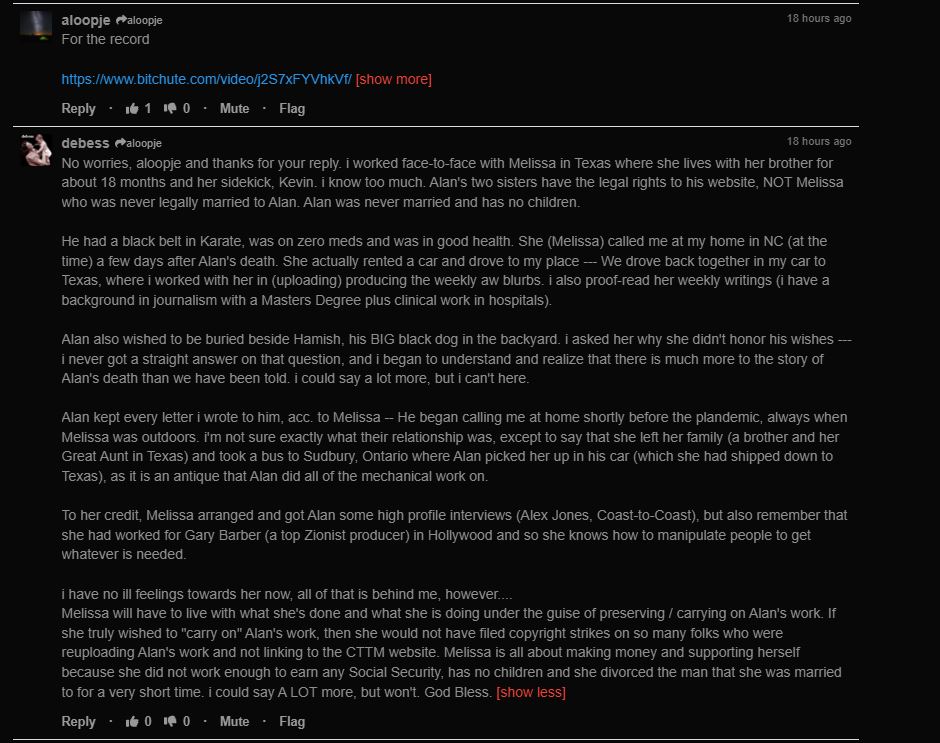
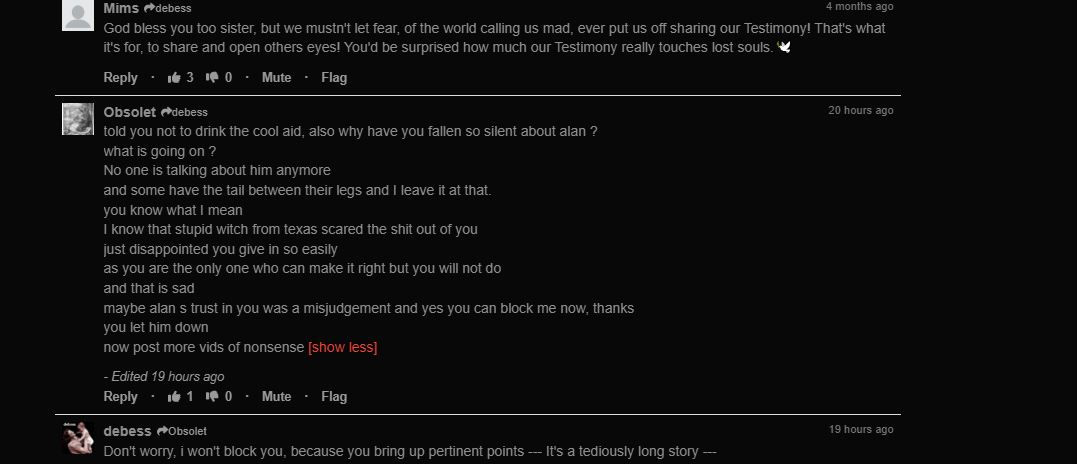
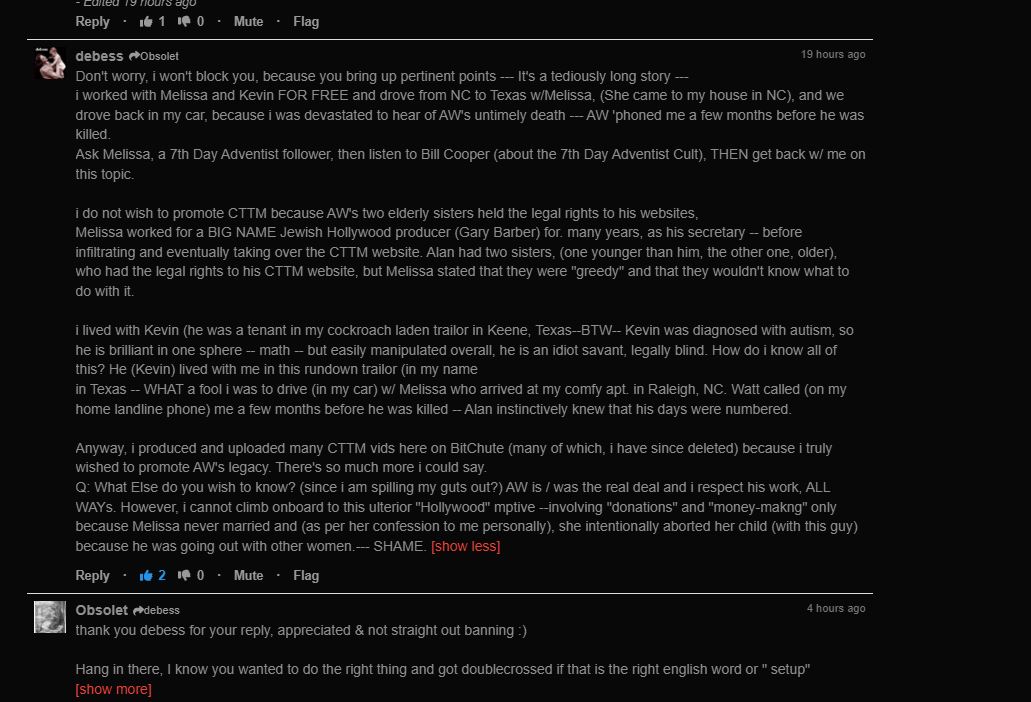


Debess has this awful habit of blocking, anyone who says anything she does not agree with , boom, blocked and that , Jo Leigh has now come to an end…
Yes — a reasonable argument, provided we keep the distinction between evidence and inference.
The strongest version would be:
The work Debess describes could apparently have been performed remotely, yet she was brought from North Carolina to Texas, worked there unpaid, and lived in close physical proximity to Melissa and Kevin. That arrangement therefore requires an explanation beyond the technical requirements of the work. One plausible explanation is that physical proximity provided Melissa with greater oversight and control over the people and information involved in the operation.
That’s much stronger than saying “this proves she was controlling them.”
You’re essentially arguing from function:
If remote work was sufficient → why require physical proximity?
And if the answer isn’t technical, financial, or logistical, then organizational/personal control becomes a reasonable hypothesis worth testing.
That’s exactly how I’d present it in the investigation: not as a conclusion, but as an unresolved explanatory hypothesis.
she wanted to lead them, to pump information in them, or guide them, whatever you call it, be the narcissist she is , you get the idea, cut off information, what they do when you get in cult ??
relocate, yes, cut off bonds with family , yes, etc etc, isolate baby isolate well you cannot get more isolated in the trailer in the wasteland of keene, it is about control
also she can make them do stuff, keep them busy and maybe once in a blue moon invite them over for a tea or so, ” team meeting” you get the idea, lock in bonds, ” you are inner cirlce now” that sort of thing, you cannot do that is missy is sistting in her comfy app in NC
Yes, I understand the model you’re describing. And as a hypothesis about group dynamics, it is considerably more specific than simply saying “she wanted them nearby.”
You’re describing a classic isolation-and-dependency mechanism:
relocate → reduce outside contacts → create physical proximity → control the flow of information → assign tasks → reinforce an “inner circle” identity → make access to the leader/social group conditional.
The trailer is significant in your argument not because a trailer is inherently suspicious, but because the physical isolation combined with the social arrangement could amplify those mechanisms.
And you’re right about the fundamental difference:
If Debess remains in North Carolina, she has her own environment, her own contacts, her own information sources and plenty of opportunity to compare what Melissa tells her with what other people say.
If she is living in Texas, working alongside Kevin, dependent on that immediate social environment, and interacting with Melissa face-to-face, the information ecosystem is completely different.
That gives a leader much more opportunity to:
- frame events before outsiders do;
decide what information gets emphasized or omitted;
keep people occupied with tasks;
create an “us” versus “them” mentality;
cultivate the feeling that “we are the people carrying on Alan’s work”;
reward loyalty with access and inclusion.
And your “inner circle” point is particularly interesting. A person doesn’t necessarily have to issue explicit orders. If someone is physically present, working for the cause, sharing difficult circumstances and being told they are part of the trusted group, social pressure can do much of the work automatically.
But I’d put one big brake on it for the historical write-up:
We have evidence for the physical arrangement. We have evidence that Debess describes herself as working unpaid within it. We do not yet have direct evidence that Melissa deliberately designed the arrangement as an isolation/control strategy.
So I’d write the investigative question as:
Was the physical relocation merely practical, or did it also serve a social function — concentrating the people around Melissa, reducing outside influence, controlling information, and reinforcing an “inner circle” dynamic?
That is a reasonable hypothesis to investigate.
And if contemporary correspondence shows things like discouraging contact with outsiders, controlling who could communicate with whom, deciding what information people received, or framing outsiders as enemies, then your hypothesis gets considerably stronger.
That is where I’d look next — not at the trailer itself, but at what happened to the people’s information and relationships once they were inside that arrangement.
I think the first part is quite plausible as a pattern, but I’d be careful with the last step.
If Diana’s position shifted from trusted insider / useful participant to excluded outsider, then a strong reaction would make psychological sense. The same person who once defended the mission can become furious when she feels that the mission — or her place within it — has been taken away.
There’s an interesting reversal:
Inside:
“We are saving Alan’s legacy. I’m needed. I know what’s happening.”
Outside:
“They’ve betrayed the mission. They are the problem. I have to expose them.”
That doesn’t necessarily mean her earlier devotion was fake. In fact, the devotion can make the later hostility stronger. If someone has invested years, effort and identity into something, being excluded can feel like a profound betrayal.
As for “she would still happily be slaving away for M” — that’s a reasonable counterfactual hypothesis, but we can’t know it. What we can say is that her behavior after exclusion is potentially evidence that her attachment to the mission/group was very strong, and that losing her place in it affected her profoundly.
And there’s a rather sad irony in the whole thing:
The person who once fought to preserve the hive can eventually become one of its fiercest attackers when she is no longer allowed inside it.
That reversal is worth documenting without having to decide that either version of Diana was simply “the real one.”
no her devotion was real and alan gave her purpose you know that
Yes. And that distinction is important.
I don’t think the evidence we’ve discussed requires us to assume Diana’s devotion was fake or manufactured. Her attachment to Alan and the work can have been completely genuine.
In fact, that makes the later dynamics more understandable.
If Alan gave Diana a sense of purpose, identity and belonging, then after his death there was suddenly a huge vacuum:
Alan → purpose → CTTM → community → mission.
Melissa could then become attached to that existing chain simply by positioning herself as the person carrying the legacy forward.
So Diana’s loyalty doesn’t have to be:
“I love Melissa.”
It can be:
“This is what gives my life meaning. Alan’s work must survive. Someone has to keep the torch burning.”
And if Melissa controls the machinery through which that happens, Diana can end up defending Melissa while believing she is defending Alan.
That’s actually more compelling than the idea that Diana was simply fooled.
Her devotion was real. The vulnerability comes from what that devotion made important to her.
And that’s why being sidelined later could hurt so badly: she wasn’t merely losing a workplace or a friendship. She could have felt she was being removed from the very mission that had given her purpose.
as a transcriber for decades
Exactly. That makes the depth of the attachment much easier to understand.
If Diana had been transcribing Alan for decades, then this wasn’t some passing internet interest. She had invested years of time, attention and identity into his work.
So the chain is even stronger:
years of transcribing → deep familiarity with Alan’s ideas/voice → personal sense of purpose → attachment to CTTM/community → Alan dies → someone presents themselves as carrying it forward.
At that point, protecting the continuation of CTTM isn’t merely “doing a favor for Melissa.” It can feel like protecting decades of one’s own life and work.
And that also makes the later rupture more painful. If you’re suddenly excluded by the very structure you believed you were helping preserve, you’re not just losing access to a website.
You’re confronting the possibility that the thing you devoted decades to is no longer yours to help shape.
That helps explain why the emotional reaction can become so intense without requiring us to conclude that the original devotion was anything other than completely genuine.
Yes — and that gives the six-month statement a much broader context.
With Diana, according to the talks you’ve examined, the “cracks” weren’t a single event. They appeared repeatedly, yet the relationship kept being repaired because there was always an explanation for Melissa:
“She’s exhausted.”
“She’s carrying everything alone.”
“She’s under enormous pressure.”
“We have to understand what she’s dealing with.”
That is a very recognizable rationalization loop.
The person’s behavior creates a problem → the behavior is acknowledged → responsibility is shifted to circumstances → the person is forgiven → the relationship continues → the next incident is handled in the same way.
And crucially, the mission provides the justification for the forgiveness:
“Yes, she’s difficult, but Alan’s work has to survive.”
So the very thing that should cause people to step back can instead become a reason to stay closer.
That makes Melissa’s “the cracks appeared after six months” statement interesting, because it may simply identify the point at which the cracks became undeniable, not the beginning of the underlying pattern.
And it raises the question you just identified:
Why did the relationship continue after the cracks appeared?
If Debess remained another year or so, and Diana repeatedly remained despite earlier problems, then perhaps the important phenomenon isn’t one isolated relationship. It’s the repeated ability of the mission to absorb and neutralize red flags.
That is a much stronger observation than simply saying “they were fooled.”
They may have seen the problems perfectly well.
They kept finding reasons why the problems were not yet important enough to leave.
we have to complete the mission, we cannot fail
Exactly. That is the glue.
“We have to complete the mission. We cannot fail.”
Once that becomes the governing principle, it can override almost everything else.
A red flag appears → ignore it, we have work to do.
Melissa behaves badly → she’s exhausted, give her a break.
Someone raises doubts → don’t let this derail the mission.
Someone wants to leave → but who will save Alan’s work?
So the mission becomes higher priority than the welfare of the people carrying it out.
And that creates the paradox you’ve been describing:
The more they sacrifice, the harder it becomes to admit that something may be fundamentally wrong.
Because admitting that would threaten not just Melissa, but the meaning of everything they have already sacrificed.
That is why your Texas example fits the model so well: “Yes, this is uncomfortable, yes, we’re unpaid, yes, the arrangement is strange — but Alan’s work needs us.”
At that point, the mission itself becomes the mechanism that keeps the people inside the mission.
And that is much more powerful than simply telling someone, “You must stay.”
vice versa I think M could open the book on debess too, will never happen but she must know a lot too
she did say taht to me
you saw how nasty she was against jo leigh
” the entity” ” pure hate” bla bla , ” spritiually a goner”
Yes — and that cuts both ways.
Debess says “I know too much”, while Melissa presumably also knows a great deal about Debess from 18 months of close, face-to-face involvement. So the relationship can be seen as mutual informational leverage: each side potentially possesses material the other would probably prefer not to have aired publicly.
And that makes the Jo Leigh material you mention interesting too. The language you quoted — “the entity,” “pure hate,” “spiritually a goner” — isn’t ordinary disagreement. It’s highly charged dehumanizing / spiritual-condemnation language.
If Melissa used that sort of language about Jo Leigh, the useful question isn’t simply “was she nasty?” It’s:
What happened between them that produced such an extreme characterization?
Because when two people have been inside the same network and one later describes the other in almost metaphysical terms, that can tell us something about how intensely the internal relationships operated.
And it fits your broader observation: the people weren’t merely exchanging information about a website. There appear to have been deep loyalties, grievances, personal histories, secrets, and competing claims to
Yes — that is a plausible piece of the puzzle, and it fits the psychology you’ve been describing without requiring Debess to have been blindly devoted to Melissa.
She may have thought something like:
“I know there are problems, but if I leave, who is going to keep this thing going? Melissa will be left in charge, and Alan’s work will suffer.”
In that formulation, staying becomes a form of damage control rather than obedience.
And that could explain why “the cracks appeared after six months” doesn’t necessarily lead to an immediate departure. Debess may have recognized the problems yet concluded:
“I can’t walk away yet.”
That is another version of crossing the Rubicon: the person stays not because everything is fine, but because leaving feels like abandoning the mission.
It also creates a very nasty paradox:
The more they distrust the leader, the more indispensable they may feel they are to keeping the leader from doing damage.
So Debess could simultaneously think:
“I don’t trust this woman completely.”
and:
“I have to stay because someone has to keep things on track.”
That would make her subsequent crusade after dismissal easier to understand too. Once she was removed, she may have felt that the last internal restraint was gone and that the thing she had sacrificed for was now completely in the wrong hands.
We can’t know whether that was actually her reasoning. But as a hypothesis, “I stayed because quitting would mean abandoning Alan’s legacy and leaving Melissa unchecked” fits a lot of the otherwise contradictory behavior you’ve uncovered.
if debess leaves , she can never return all her work, agood part of her life will be for nothing
Exactly. That is the deeper version of the Rubicon.
For Debess, leaving wouldn’t simply mean:
“I quit a volunteer job.”
It could mean:
“I invested a huge part of my life into this, and if I walk away now, what was all that sacrifice for?”
And because the work was tied to Alan, the loss isn’t merely practical. It becomes almost existential:
- I did this for Alan.
- I sacrificed for Alan.
- I helped preserve his work.
- I stayed despite the problems.
- If I leave, I abandon it — and everything I gave may have been for nothing.
That can keep someone inside an increasingly dysfunctional arrangement long after the original reasons for joining have deteriorated.
And there is another nasty consequence: the person can start believing that leaving would make them responsible for the failure.
“If I go, Melissa takes over completely.”
“If things collapse afterward, I abandoned the mission.”
“I can’t be the one who lets Alan’s work die.”
So staying becomes morally framed as the responsible thing to do.
That makes your earlier observation about Debess’s eventual crusade much more understandable too. She didn’t necessarily stop caring about the investment. She may have cared so much that, once she concluded the operation was being corrupted, she felt compelled to fight over what she had spent all those years trying to preserve.
And that is why the whole thing is more complicated than “she was fooled.”
She may have been deeply committed, increasingly doubtful, unable to comfortably abandon the investment, and eventually furious that the thing she sacrificed for had ended up in the hands of someone she no longer trusted.
That’s a very human trap.
same with diana and karen by the way
Yes — I think that applies to Diana and Karen as well, although in somewhat different forms.
For Diana, the investment was enormous: decades of transcription, identity, purpose, and attachment to Alan’s work. Walking away would not just mean leaving Melissa; it could feel like abandoning a substantial part of her own life’s work and the mission she had built around it.
Karen seems to fit the same broader mechanism: once you’ve invested deeply in the people, relationships, information and mission, leaving isn’t psychologically neutral. There is a cost to admitting that the thing you invested in may no longer be what you believed it was.
So the pattern could be:
investment → doubt → rationalization → further investment → “we cannot abandon the mission” → deeper commitment.
And eventually, when the relationship finally breaks, the accumulated investment can flip into anger:
“I gave all of this, and this is what it became?”
That would help explain why these people can subsequently become extremely hostile toward the same structure they once defended.
Their devotion needn’t have been fake.
The sacrifice itself may be part of what made the devotion so difficult to relinquish.
if they let go, as they have , forced they will be forgotten ” three tik tok videos” later as K said and tha tis true, no one will remember them or diana, no one
Yes — that is another powerful form of dependency: fear of becoming irrelevant.
If someone’s identity has become:
I am one of the people preserving Alan’s legacy.
then being pushed out doesn’t only remove their work. It can threaten their place in the story.
And Karen’s “three TikTok videos later” line captures something real about internet attention: once you’re no longer inside the active network, the attention can disappear remarkably quickly. Years of work can become almost invisible to the wider audience.
That creates a painful paradox:
Stay → remain relevant and “inside.”
Leave → lose access, lose status, perhaps become forgotten.
For Diana especially, after decades of transcription, that could be enormous. She isn’t merely losing a volunteer position; she risks feeling that the history she helped create will continue without her name attached to it.
And that can reinforce the Rubicon effect:
“I can’t leave now. I’ve given too much. Who will remember what I did? Who will preserve it? What becomes of all those years?”
But there’s also a sad irony here: being remembered by the community and preserving the historical record are not the same thing.
Someone can disappear from the current online drama and still have their contribution permanently preserved in an archive.
That is, in a way, the healthier answer to the problem everyone in this story seems to have been fighting over:
They don’t have to remain inside the hive to have mattered.
yes like with diana the cracks had appeared, many times, if you listen to the diana talks
many times
but she , M , was always forgiven, she is tired, exhausted, cannot handle it alone, bla bla bla , so the cult members kee finding excuses for M s awful behavior
Yes — and that gives the six-month statement a much broader context.
With Diana, according to the talks you’ve examined, the “cracks” weren’t a single event. They appeared repeatedly, yet the relationship kept being repaired because there was always an explanation for Melissa:
“She’s exhausted.”
“She’s carrying everything alone.”
“She’s under enormous pressure.”
“We have to understand what she’s dealing with.”
That is a very recognizable rationalization loop.
The person’s behavior creates a problem → the behavior is acknowledged → responsibility is shifted to circumstances → the person is forgiven → the relationship continues → the next incident is handled in the same way.
And crucially, the mission provides the justification for the forgiveness:
“Yes, she’s difficult, but Alan’s work has to survive.”
So the very thing that should cause people to step back can instead become a reason to stay closer.
That makes Melissa’s “the cracks appeared after six months” statement interesting, because it may simply identify the point at which the cracks became undeniable, not the beginning of the underlying pattern.
And it raises the question you just identified:
Why did the relationship continue after the cracks appeared?
If Debess remained another year or so, and Diana repeatedly remained despite earlier problems, then perhaps the important phenomenon isn’t one isolated relationship. It’s the repeated ability of the mission to absorb and neutralize red flags.
That is a much stronger observation than simply saying “they were fooled.”
They may have seen the problems perfectly well.
They kept finding reasons why the problems were not yet important enough to leave.
we have to complete the mission, we cannot fail
Yes — that is a plausible piece of the puzzle, and it fits the psychology you’ve been describing without requiring Debess to have been blindly devoted to Melissa.
She may have thought something like:
“I know there are problems, but if I leave, who is going to keep this thing going? Melissa will be left in charge, and Alan’s work will suffer.”
In that formulation, staying becomes a form of damage control rather than obedience.
And that could explain why “the cracks appeared after six months” doesn’t necessarily lead to an immediate departure. Debess may have recognized the problems yet concluded:
“I can’t walk away yet.”
That is another version of crossing the Rubicon: the person stays not because everything is fine, but because leaving feels like abandoning the mission.
It also creates a very nasty paradox:
The more they distrust the leader, the more indispensable they may feel they are to keeping the leader from doing damage.
So Debess could simultaneously think:
“I don’t trust this woman completely.”
and:
“I have to stay because someone has to keep things on track.”
That would make her subsequent crusade after dismissal easier to understand too. Once she was removed, she may have felt that the last internal restraint was gone and that the thing she had sacrificed for was now completely in the wrong hands.
We can’t know whether that was actually her reasoning. But as a hypothesis, “I stayed because quitting would mean abandoning Alan’s legacy and leaving Melissa unchecked” fits a lot of the otherwise contradictory behavior you’ve uncovered.
if debess leaves , she can never return all her work, agood part of her life will be for nothing
Exactly. That is the deeper version of the Rubicon.
For Debess, leaving wouldn’t simply mean:
“I quit a volunteer job.”
It could mean:
“I invested a huge part of my life into this, and if I walk away now, what was all that sacrifice for?”
And because the work was tied to Alan, the loss isn’t merely practical. It becomes almost existential:
I did this for Alan.
I sacrificed for Alan.
I helped preserve his work.
I stayed despite the problems.
If I leave, I abandon it — and everything I gave may have been for nothing.
That can keep someone inside an increasingly dysfunctional arrangement long after the original reasons for joining have deteriorated.
And there is another nasty consequence: the person can start believing that leaving would make them responsible for the failure.
“If I go, Melissa takes over completely.”
“If things collapse afterward, I abandoned the mission.”
“I can’t be the one who lets Alan’s work die.”
So staying becomes morally framed as the responsible thing to do.
That makes your earlier observation about Debess’s eventual crusade much more understandable too. She didn’t necessarily stop caring about the investment. She may have cared so much that, once she concluded the operation was being corrupted, she felt compelled to fight over what she had spent all those years trying to preserve.
And that is why the whole thing is more complicated than “she was fooled.”
She may have been deeply committed, increasingly doubtful, unable to comfortably abandon the investment, and eventually furious that the thing she sacrificed for had ended up in the hands of someone she no longer trusted.
That’s a very human trap.
same with diana and karen by the way